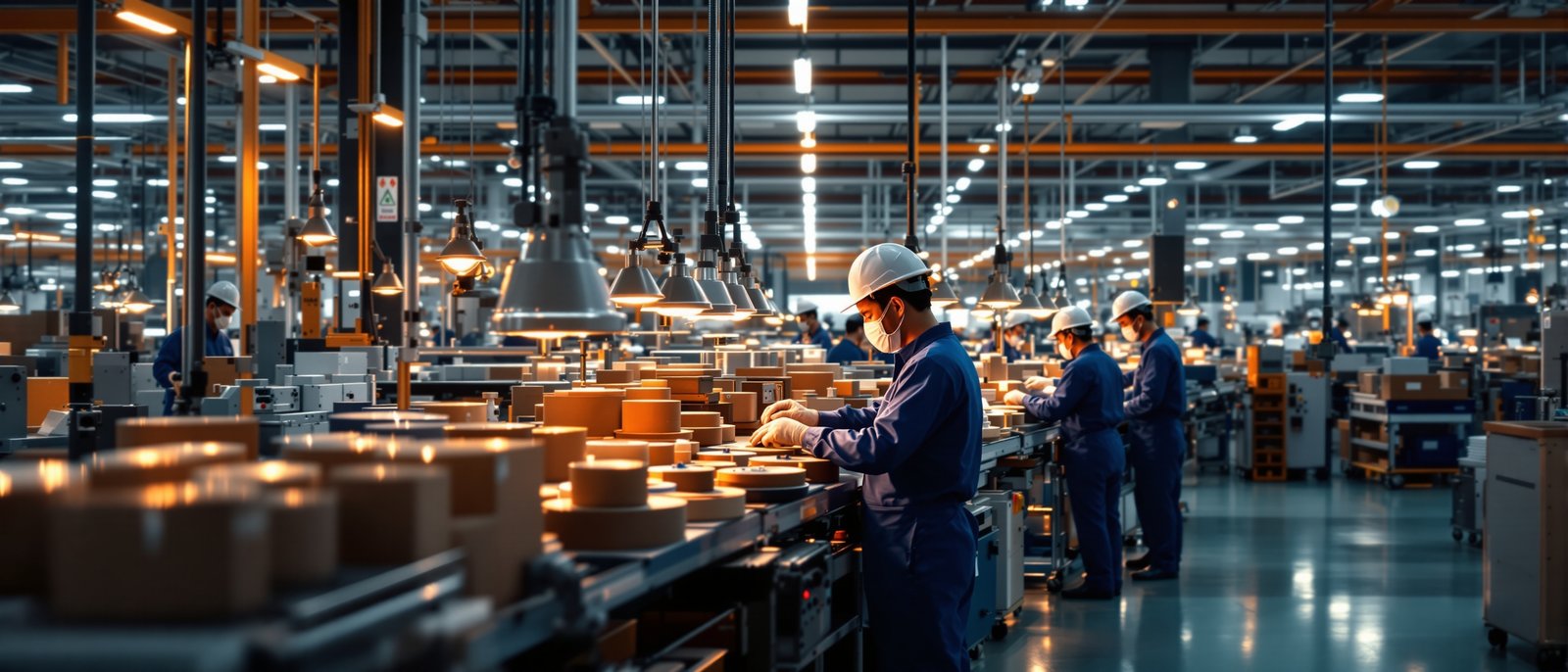
China Sourcing Agent — Factory Sourcing & Supplier Verification
Access China's manufacturing power through our permanent Dongguan office. We find, audit and manage the factories behind your products — so you don't have to fly to Guangdong to do it yourself.
Why Importers Use a Sourcing Agent With an Office in China
Buying directly from a Chinese factory looks simple on a marketplace listing and becomes complicated everywhere else. The supplier who answers your enquiry may be a trading company reselling another factory's output. The quoted price may exclude tooling, packaging, certification or inland freight. The sample you approve may not match the goods that leave the port three months later. None of this is exotic — it is the ordinary friction of buying manufactured goods from eight thousand kilometres away, in a second language, from a company you have never visited.
A sourcing agent exists to absorb that friction. The value is not in finding suppliers — anyone can find suppliers. The value is in knowing which ones can actually build your product at your volume, at your quality level, on your timeline, and then staying physically close to the production while it happens.
McORven Trading runs a permanent office in Dongguan, Guangdong Province. That is the difference between a sourcing partner who forwards emails and one who can be standing on a factory floor the same afternoon. When a supplier's answers stop making sense, when a pre-production sample arrives wrong, when a production line slips two weeks behind, somebody from our team goes and looks. Our Gibraltar headquarters then holds the commercial relationship, the contract and the documentation on the European side, so you are dealing with an EU-adjacent counterparty rather than a company you can only reach through a messaging app.
What Our China Sourcing Service Covers
Sourcing is not a single task. It is six or seven distinct jobs that most importers discover one at a time, usually at the worst moment. We handle all of them under one engagement.
Factory search and shortlisting
We start from your specification, not from a supplier directory. Our Dongguan team identifies manufacturers with genuine production capability in your category, filters out trading companies presenting themselves as factories, and returns a shortlist with capacity, existing export markets, certification status and indicative pricing — so you are comparing real options rather than sales pitches.
Supplier verification and factory audit
Before any money moves, we confirm the company exists as described. Business licence and registered scope, export licence, ownership, workforce size, machinery on the floor, quality systems and existing client references. Where the product category requires it, we check for the certifications your destination market will demand — CE, RoHS, REACH, EN standards for protective equipment, food-contact compliance and similar.
Sample management
We obtain, inspect and ship pre-production samples, and we document what was approved. That approved sample becomes the physical reference against which production is later inspected. Disputes about quality almost always come down to the absence of an agreed reference; we make sure one exists in writing and in a box.
Price and terms negotiation
We negotiate in Mandarin, with knowledge of what comparable production actually costs. That covers unit price, tooling and mould costs, minimum order quantity, payment terms, packaging, lead time and penalties for late delivery — the terms that determine whether a cheap unit price is genuinely cheap.
Production monitoring and quality control
We inspect during production, not only at the end, because a defect found at 20% completion is a correction and a defect found at 100% completion is a negotiation. Pre-production checks, in-line inspection and pre-shipment inspection against an agreed AQL standard.
Export documentation and logistics coordination
Commercial invoice, packing list, certificate of origin, HS classification, export declaration and the booking itself. We coordinate sea freight in full container and consolidated loads, air freight where speed justifies the cost, and door-to-door delivery through established forwarders.
Our Sourcing Process, Step by Step
Every engagement follows the same sequence. You always know which stage you are at and what happens next.
Briefing
You describe the product, the target landed cost, the quality level, the destination market and the volume you expect in year one. If you have drawings, a specification sheet, a competitor's product or a physical sample, we work from that. If you have an idea and a target price, we tell you honestly whether the two are compatible before anyone spends money.
Factory search
Our Dongguan team works the category, drawing on existing relationships across Guangdong and, where the product is made elsewhere in China, our wider manufacturer network. You receive a shortlist with capability notes and indicative pricing, typically within one to two weeks depending on complexity.
Verification and audit
We visit the shortlisted factories. Credentials are checked, production capacity is assessed against your volume, quality systems are reviewed and the line is photographed. You get an audit summary on each candidate — including the ones we recommend against, and why.
Samples
Pre-production samples are produced, inspected by our team in China and shipped to you. Revisions are managed until the sample is right. Nothing proceeds to production until you have physically approved what you are buying.
Negotiation and order placement
We agree unit price, MOQ, payment schedule, packaging, lead time and inspection standard, then place the order with the terms documented. Payment structures are arranged to keep leverage on your side until goods are inspected.
Production, inspection and shipment
We monitor the run, inspect during and after production, and manage export documentation and booking. You receive inspection reports with photographs before the goods are released for shipment.
How We Verify a Factory Before You Commit
Supplier verification is the part of sourcing that importers most often skip and most often regret. A factory audit is not a formality — it is the difference between a supplier who can build your product and one who will subcontract it quietly to a workshop you will never see.
Our verification covers four areas. Legal existence: business licence, registered capital, registered business scope, export licence and whether the entity you are invoiced by is the entity that manufactures. Production capability: machinery, line count, workforce, current utilisation and whether your order is a rounding error or a strain on their capacity — both are risks, for different reasons. Quality systems: incoming material inspection, in-process control, testing equipment, defect handling and whether documented procedures are actually followed rather than framed on a wall. Commercial track record: existing export markets, client references, and how they respond when asked a technical question they cannot answer easily.
We report what we find, including when the finding is inconvenient. A shortlist where every factory is excellent is a shortlist that has not been checked.
Quality Control at Every Production Stage
Quality is managed across the production timeline, not tested at the end of it.
Pre-production: we confirm that materials and components match the approved sample, and that the factory has understood the specification in the same way you do. During production: an in-line inspection at roughly 20–40% completion catches systematic defects while they can still be corrected within the original schedule. Pre-shipment: a final inspection against an agreed AQL sampling standard, with photographic reporting, before the goods are released and before final payment.
Where a destination market requires independent testing — electrical safety, chemical composition, textile or toy standards — we arrange third-party laboratory testing and provide the certificates with the shipment documentation. Our team also partners with independent quality control agencies when a client prefers an inspection body with no relationship to the sourcing agent.
How Sourcing Agents Charge, and How We Structure It
Fee structures in this industry are rarely published, which makes comparison difficult. There are three common models, and it is worth understanding all three before you engage anyone.
Commission on order value is the most common: the agent takes a percentage of what you spend. It is simple, but it aligns the agent's income with a higher purchase price unless the relationship is a long one. Fixed service fee charges for the work itself — search, audit, inspection, coordination — independently of order value, which removes that conflict but requires a clear scope. Buy-and-resell means the agent purchases the goods and sells them to you at their own price; convenient, but the factory price becomes invisible to you.
We agree the model and the number in writing before work begins, and we tell you which factory quoted what. An importer who cannot see the factory price cannot tell whether they are being served or farmed. Where a project involves tooling, certification or laboratory testing, those costs are quoted separately and passed through at cost rather than marked up quietly.
Sourcing From Dongguan and the Guangdong Manufacturing Cluster
Dongguan sits between Guangzhou and Shenzhen in the Pearl River Delta, one of the densest manufacturing regions in the world. Within roughly two hours of our office there are established clusters for electronics and electrical components, furniture and home goods, footwear and apparel, toys, packaging, hardware and plastics, machinery and industrial supplies.
Physical proximity matters more than it sounds. It means a factory visit is a morning, not an expedition. It means samples move in days rather than weeks. It means when a supplier says a line is running, somebody can verify that claim in person. And it means we can compare several manufacturers in the same category within a single week, because they are geographically concentrated.
Where a product is not made in Guangdong — ceramics, certain textiles, specific machinery categories — we source from the relevant region rather than forcing an unsuitable local supplier onto a client. Our team speaks Mandarin, Cantonese and English, which removes the translation layer where most sourcing errors are actually introduced.
The Five Mistakes That Cost Importers the Most
Most sourcing failures are not exotic. The same five appear again and again, and all of them are avoidable.
Choosing on unit price alone. The cheapest quote usually excludes something — tooling, better packaging, a compliant material, or a realistic defect rate. The landed cost of a rejected container is far higher than the saving that caused it.
Mistaking a trading company for a factory. There is nothing wrong with buying through a trading company, but you should know that is what you are doing, because it changes who controls quality and how much margin sits between you and the production line.
Approving a sample informally. A sample approved by photograph, over a messaging app, with no retained physical reference, is not an agreement. It is a memory, and memories diverge.
Paying too much, too early. Payment terms are leverage. Once the balance is paid, a supplier's incentive to fix a problem drops sharply. Inspection before final payment is the single most effective control an importer has.
Skipping inspection to save time. The inspection that gets cancelled to hold a shipping date is the inspection that would have caught the defect. Building inspection into the schedule from the start costs nothing; adding it under pressure costs the schedule.
Lead Times: What Actually Drives Them
Importers usually plan around production time and are surprised by everything else. A realistic timeline has five components, and production is rarely the longest.
Sourcing and verification typically runs one to three weeks, depending on how specialised the product is and how many factories need to be visited. Sampling is the stage most often underestimated: two to five weeks is normal, and more if tooling or moulds are involved, because each revision round is a full cycle. Production depends on quantity and category, commonly three to six weeks, though it stretches significantly around Chinese New Year and Golden Week when factories close and the backlog on either side is severe.
Inspection and release adds a few days. Freight is then roughly thirty to forty days by sea to Northern Europe, less to the Mediterranean, or under a week by air at several times the cost.
We give you the whole timeline at the briefing stage, including the parts that are outside anyone's control, so that your own commitments downstream are based on something real. If a date is not achievable, we say so before the order is placed rather than explaining it afterwards.
OEM, ODM and Private Label Manufacturing
Not every importer wants an existing product. Where you are building your own, the sourcing job changes shape.
OEM means the factory manufactures to your design and your specification — you own the product definition, they own the production. ODM means you start from a design the factory already has and adapt it: faster and cheaper, but the base design is not exclusive to you. Private label is narrower still — an existing product carrying your branding and packaging.
Each route has different implications for tooling cost, minimum order quantity, lead time and intellectual property. Tooling and moulds are usually the largest one-off cost and the point where ownership needs to be agreed explicitly in writing: who paid for the mould, who holds it, and what happens to it if you change supplier. We put that in the order documentation rather than leaving it to assumption, because a mould you paid for and cannot remove is a supplier relationship you cannot leave.
Who We Work With
Our sourcing clients are typically importers, wholesalers, distributors, retailers and brand owners in Europe, the United Kingdom, the Middle East, Africa and the Americas — businesses that need manufactured goods in commercial volumes and need them to arrive as specified.
We work equally with companies importing for the first time and with established importers replacing a supplier relationship that stopped working. First-time importers usually need the process explained and the risks made visible. Experienced importers usually need a pair of hands on the ground in Guangdong and an inspection regime they can trust. Both are the same job, approached differently.
We are less suited to single-unit purchases, dropshipping and one-off consumer orders. Our structure — office, audits, inspections, documentation — is built for commercial quantities, and the cost of that structure only makes sense at that scale.
Start Your China Sourcing Project
Tell us what you want made or bought, the volume, the target price and the market it is going to. We will tell you whether it is realistic, what it will genuinely cost, and how long it will take — before you commit to anything. Our Gibraltar office holds the commercial relationship and the paperwork; our Dongguan office does the work on the ground.